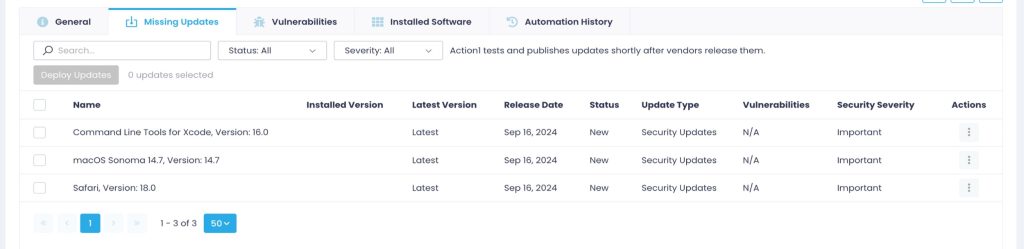
 Action1 has announced the latest release of its leading patch management solution. The update, called Aliso Beach, contains a new agent for macOS, including support for macOS Sequoia. It will allow organisations to use a single platform to manage all their patch management requirements across endpoints.
Action1 offers its solution free of charge for the first 100 Endpoints across macOS and Windows for organisations that want to test it out. Action1 says this is not a free trial. It has no feature limits and never expires. It also includes a free initial vulnerability assessment for unlimited endpoints.
 Action1 believes itself to be the easiest-to-use patch management solution. G2 placed it as the top vendor in its top 20 Easiest-to-Use Patch Management Software. It scored well above average for ease of administration, ease of use, and meeting the requirements. The introduction of macOS also makes it suitable for organisations that have a mix of platforms.
Why is macOS increasing in importance?
According to SecureMac, in 2021, macOS has a 23% market share in enterprise environments. In February 2024, Statista put the macOS share of the global market at 15.42%, second behind Windows, which has a 72.17% share.
According to the Action1 Software Vulnerability Ratings Report 2024, macOS and iOS saw an increase of over 30% in exploited vulnerabilities. It is now more urgent than ever for firms to have a comprehensive patching solution across their entire device estate,

Mike Walters, President and co-founder of Action1, commented, “With the growing complexity of IT ecosystems, it is a challenge for IT teams to unify vulnerability discovery and patching across all systems. Almost every Action1 customer has a mix of Windows and Mac endpoints. The new macOS support will help our customers protect all endpoints and eliminate security gaps that could expose them to cyber threats targeting vulnerabilities.”
For many customers, this update has been long awaited. An example of the enthusiasm for it was found on Reddit with one customer noting, “Most anticipated release of 2024. Beats Google’s Pixel, Gemini releases, iPhone 16 and all that Apple Intelligence jazz for me.”
Aliso Beach doesn’t disappoint
The macOS update is not the only feature in this latest release. Other features enhance the product in areas such as functionality, security, and usability. They include:
Addressing NVD Vulnerability Backlog
Action1 can now detect software vulnerabilities for applications listed in its Software Repository beyond the National Vulnerability Database (NVD) data. Given the alarming slowdown of NIST NVD updates, this critical capability adds much-needed visibility over many previously undetected vulnerabilities and allows them to automate their remediation.
Software Installation Customization
This new feature allows customization of both built-in and custom packages without cloning. For example, you can append license keys to install switches or override other organization-specific parameters (e.g., Site ID for XDR agents). Package customization without cloning is now available for the entire enterprise, per organization, or even per endpoint group.
You can also enable continuous and fully automated patch compliance for customized software while eliminating routine manual updates. This new feature is currently only available for Windows installation packages.
Real-Time Endpoint Attribute Reporting
Action1’s reporting capabilities have been improved by adding endpoint attributes. Supported attributes are usernames, comments, OS types, IP addresses, and custom ones. They are available as selectable columns in custom reports.
Expanded API
The new API documentation is now more complete. It includes new features and sample code, such as custom package upload methods, moving endpoints between groups, user management, report data recovery, and more. The update also includes revised REST endpoint names consistent with UI terminology (such as automations instead of policies).
The legacy API names remain available for backward compatibility with existing integrations. Many Action1 users utilize the API for custom integrations. This new update uncovers previously inaccessible features and enables even more automation.
Installation warnings for unsigned custom packages
The new option allows switching off warnings for custom packages not signed by software manufacturers. Use this at your own risk, and preferably only for software that comes from trusted vendors or software developed in-house.
Missing update status for pending per-user uninstalls
This highly requested new setting removes missing update status for pending per-user uninstalls. Enabled by default, all software pending uninstallations in inactive user profiles will be treated as completed, with all vulnerabilities marked as resolved and no longer shown as needing remediation. When disabled (the previous behaviour), the vulnerabilities will be treated as present until the uninstallation completes upon the user’s next login.
Multiple Usability Enhancements
The release introduces several UI improvements, which include
- The ability to move endpoints between groups.
- Reworked endpoint organization controls (move, delete, add) make the organization of endpoints much more intuitive.
- Quick renaming of automations supported without going through the automation configuration wizard.
- Clicking on an expanded report folder now collapses it.
- Better UI experience for users with limited roles: controls are no longer hidden but display errors saying the user does not have access.
- Endpoint and endpoint group names are now shown in the automation history.
- It now remembers the sort order in views between logins.
- Automatic EULA acceptance in patch management automations.
Enterprise Times: What does this mean
Aliso Beach is a comprehensive update from Action1 that includes one significant new feature and many other updates. The firm is on track to reach $100 million ARR and is determined to remain founder-led. It has turned down all offers to acquire it.
With the addition of macOS support, the solution will be able to provide a single solution for a wider range of clients. It does need to update its Supported Operating Systems page (macOS was not visible as of writing this article) and one wonders how long it will be before it looks to add Linux to this list as well.